The Case for Investing in Nonprofit Talent

By Hanh Le, Exponent Philanthropy, and Rusty Stahl, Talent Philanthropy

Adapted from materials created by Jessica Bearman, Mark Sedway, and Rusty Stahl for the Talent Philanthropy Toolkit (Version 1.0)

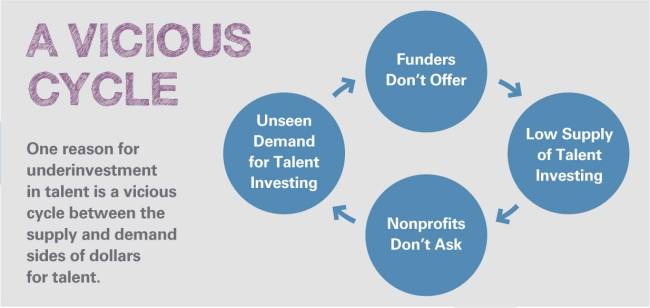
Between 1992 and 2011, according to research by Talent Philanthropy, foundations devoted less than 1% of grant dollars toward supporting the recruitment, retention, compensation, development, or retirement of nonprofit talent. In fact, the signals grantmakers send often encourage nonprofits to deemphasize staff development and stress programs and projects instead.

Given the power differential between funders and fundraising nonprofits, it will take new attitudes and actions from the funding community to turn this cycle around.

Continue reading →

Like/Love/Haha/Wow/Sad/Angry…and Better Philanthropy Support?

By Hanh Le, Exponent Philanthropy

Photo credit: Facebook

Photo credit: Facebook

Last month, Facebook released its new “Reactions” feature, expanding the original Like to Love, Haha, Wow, Sad, and Angry. According to Wired magazine, “Mark Zuckerberg had finally conceded that the platform needed a more nuanced way for users to interact with posts, for the obvious reason that not every post is likable.”

A likely outcome is that users will be more willing to share with the possibility of receiving more supportive reactions. Granted, whether we should be so knee-jerk to what we see flash on a screen is fodder for another discussion, but encouraging people to share more and, in turn, receive support from peers, that’s a good thing, right?

It’s left me thinking, what can those of us at philanthropy support organizations—this large universe of advisors and infrastructure groups—do to help philanthropists share ideas, practices, activities, and opinions so we can all learn, improve, and make a more significant impact? I have some ideas!

Continue reading →

Planning for a Ramp Up in Giving

By Hanh Le, Exponent Philanthropy

More foundations than ever before are facing the exciting prospect of significantly ramping up and increasing charitable giving and other activities.

Whether resulting from the receipt of an estate, sale of a company, or simply a decision to contribute more resources and/or spend assets more aggressively, foundations that ramp up are undergoing a shift in scale that often requires major changes in infrastructure, staffing, governance, grantmaking, and use of expert resources.

Download or order “Ramping Up Your Foundation,” created by Exponent Philanthropy and The Philanthropic Initiative (complimentary in PDF; available for purchase in hard copy) >>

The groundwork for an effective plan

Even if the timing is uncertain, many foundation boards know whether there is likely to be a growth in corpus at some point, and generally how big that growth will be. Foundations that take the time to plan ahead of a ramp up can clarify vision, explore donor intent, develop a team of advisors and board members, experiment with new approaches, and more.

Start with strategy. It is important to begin at the strategic level with a thoughtful look at the foundation’s vision for change—its mission, goals, donor legacy, and broad strategies. Experienced foundation professionals advise foundations to focus first on the more important strategic issues. Once those are clarified, tactical decisions like staffing, grant cycles, and office space can flow from them.

Continue reading →

The Power of Networks: More Than a Cliché

By Hanh Le, Exponent Philanthropy

Exponent Philanthropy and Grantmakers for Effective Organizations (GEO) partnered earlier this year to publish Supporting and Engaging in Network: Partnering for Greater Impact. Based on GEO’s Cracking the Network Code, it explores how funders are working with and through networks to achieve more with their giving—essentially, how funders can leverage the power of networks.

And there it is, a phrase we hear and see so often these days: the power of networks. When will we stop hearing people espouse “the power of the network”? Not likely anytime soon, since networks are indeed powerful, and they aren’t going anywhere. Networks, groups or systems of interconnected things or people, have been around as long as there have been things and people, and they will continue to be around as long as things and people continue to exist.

Why all the buzz now, then, and what’s the “so what” for philanthropy?

Continue reading →

Growing Community Solutions That Work: A New Way for Government

By Hanh Le, Exponent Philanthropy

Last month, the Social Innovation Fund (SIF) announced $33.7 million in grant investments to seven organizations that address youth development, economic opportunity, and healthy futures through innovative, evidence-based approaches.

What Is SIF? SIF is a White House initiative and program of the Corporation for National and Community Service that aims to demonstrate a “new way that government programs can operate.”

SIF cornerstones include:

  • Bringing together public and private resources
  • Focusing on solutions
  • Requiring evidence of results
  • Sharing successful ideas with more people
michael-smith

SIF Director Michael Smith will keynote Exponent Philanthropy’s 2014 National Conference

“Five years ago,” said SIF Director Michael Smith in a press release announcing SIF’s recent grantees, “the Social Innovation Fund was created to find solutions that work, and make them work for more people – signaling a shift in the way the government and philanthropy invest in community solutions. Five years later, we’ve become a national solutions accelerator and amplifier, investing hundreds of millions of dollars, along with our private sector partners to prove, improve and scale solutions that work.”

Who did SIF support in 2014? Two of its seven grantees, The Boston Foundation and Silicon Valley Foundation, are community foundations – a first for SIF. And all seven grantees will be using a collective impact model.

See the full list of grantees

Continue reading →

Tackling More Than You Think You Can

By Hanh Le, Exponent Philanthropy

Veronika Scott, founder and CEO of The Empowerment Plan in Detroit, is the youngest recipient of the John F. Kennedy New Frontier Award from the JFK Library Foundation and Harvard University. She received an IDEA Gold Award from the Industrial Design Society of America and is one of Crain’s 20 in Their 20s. CNN named Scott one of its 10 Visionary Women for 2014.

She’ll share her story at the closing plenary of Exponent Philanthropy’s 2014 National Conference.

Scott built The Empowerment Plan around a single idea: to design a coat specifically for the homeless that transforms into a sleeping bag and is given out across the United States to those living on the streets. That idea has now transformed into a system of empowerment in which homeless women are paid to learn how to produce coats for people living on the streets, giving them an opportunity to earn money, find a place to live, and gain back their independence.

About more than just a product, The Empowerment Plan breaks the cycle of poverty and invests in those that need it the most so they can create the life they want for themselves and their families.

Continue reading →

Conferencing to the Max

By Hanh Le, Exponent Philanthropy

The past weeks in DC have been big ones for philanthropoids, or those of us who work for philanthropic organizations. There were conferences by Emerging Practitioners in Philanthropy (EPIP), Campaign for Grade-Level Reading, Council on Foundations (COF), Joint Affinity Groups (JAG)…

Conferences are a worthwhile part of our work, but, after being out and about on the conference circuit, I  find myself back in my office with a pile of paper, a head full of ideas, and an overflowing email inbox. Guess which one screams loudest for my attention? It’s hard to resist the call of email, so I do my best to stay on top of urgent emails while I’m out. That helps ensure I can dedicate that important time right afterward to following-up on ideas, actions, and connections that proliferate at good conferences.

Soon after returning to the office last week, I had the pleasure of chatting with Exponent Philanthropy’s Member Services Committee. It was fortuitous timing, as this seasoned group of conference attendees generously shared their tips for maximizing the experience when out and about at conferences.

On planning ahead

  • Dana Karlsson Campion of the Cedar Tree Foundation in Boston proactively builds conferences into her work plan, including a block of time immediately after each conference to follow up on action items that emerge during the conference.

Continue reading →

Are You Prepared for Philanthropy’s Common Transition Points?

By Hanh Le, Exponent Philanthropy

Your philanthropic journey is sure to be a remarkable one: often cyclical, rarely linear, and greatly shaped by your particular circumstances.

Are you prepared to navigate the twists and turns that are sure to arise over time? Our nearly two decades of experience working with, listening to, and observing philanthropists with few or no staff suggests seven transition points common in the philanthropic journey.

Selecting a philanthropic vehicle. There are many options for structured giving, and your choice will influence your impact, your governance and administration, and your tax advantages. Trusted philanthropic advisors are often integral to these choices, and to putting into place the vehicles you choose.

Finding a focus. Taking time to focus can help you clarify what you want to achieve and measure progress toward your goals. Many funders focus on a particular field of interest, population, or geography. Others focus by strategy (e.g., building technology capacity) and bolster a range of grantees by applying those strategies. There is no one right way to settle on a focus, and many funders consider a combination of factors to determine theirs, including passions, values, and critical community needs. See the article “Choosing a Focus”

Continue reading →

Get Into a Network Mindset

By Emily Wexler, GEO, and Hanh Le, Exponent Philanthropy

As grantmakers and nonprofits look for ways to collaborate more effectively, many are working with and through networks to achieve greater impact.

The Sunflower Foundation works with a network of 29 health care safety net providers committed to integrating medical and behavioral health systems.

Said President and CEO Billie Hall, “We see networks as a forum for learning and dialogue—bringing together diverse organizations committed to a common goal. The willingness to share experiences and strategize solutions, the collective voices, and the leadership that emerges from such a network can be the catalyst for change.”

Because networks are by definition loosely controlled and emergent, understanding how to effectively support them can be difficult for many philanthropists. The successful use of networks for collective action is typically guided by a “network mindset,” which consists of four main principles: 

Continue reading →

Going Public With Your Giving

By Hanh Le, Exponent Philanthropy

Some philanthropists decide to operate in the public realm early on. But others go public at some point over time, often when they feel compelled to act. However it emerges, going public can be a pivotal transition point and a bold act of leadership.

The Troy Savings Bank Charitable Foundation quietly awarded grants in the area of homelessness for several years. Frustrated that the funding appeared to have little impact, the board reconsidered its approach.

Said Executive Director Leslie Cheu, “We asked, ‘Could we have a bigger impact if we brought more people—both agencies and funders—to the table?’ We joined the local Ten Year Plan to End Homelessness group and worked side by side with service providers and other funders who cared about homelessness. We supported awareness activities and joined with other funders to support initiatives that targeted the root causes.”

“Although we initially felt a bit exposed by publicly showing our grantmaking interest in homelessness,” continued Cheu, “it was the best way to engage others in the issue. ‘Going public’ has paid dividends in stronger relationships across all community sectors and the development of several supportive housing programs that are making a real difference in homelessness in our region.”

Philanthropists go public in ways big and small.

Openly gathering, sharing, and spotlighting information:

  • Posing questions to a wide variety of individuals, groups, and institutions
  • Supporting or commissioning research and sharing the findings 
  • Raising awareness by writing letters to the editor, using social media, or talking with key stakeholders 
  • Confronting wrongdoing, waste, or mismanagement

Continue reading →