Shaping a Foundation’s Future While Honoring Its Past

By Stephanie Fuerstner Gillis, Arabella Advisors

We’ve had the great pleasure of serving as the grantmaking and foundation management partner for Kathleen deLaski and the deLaski Family Foundation for the past three years. The foundation brought us on to help it adapt its mission, vision, and goals in a way that makes the most of the current board’s knowledge, networks, and expertise, and allows it to respond to current challenges—all while remaining true to the foundation’s and family’s legacy.
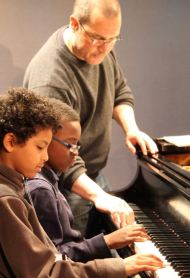
Sitar Arts Center

Students and instructor at Sitar Arts Center, a deLaski Family Foundation grantee

Kathleen deLaski’s parents, Donald and Nancy, formalized their giving in 1999. The foundation grew and eventually supported three main areas: arts and history, health and well-being, and education, mostly in the DC metro area. In 2005, Kathleen and one brother joined the board, and, shortly before Don died in 2012, Kathleen became president of the foundation. She and her two brothers were faced with a challenge that many family foundations face: How do they set a course for the future while honoring the past?

The first thing we did was to look across the foundation’s grant portfolio and ask what the giving strategy has been. Whereas Don had never expressed an interest in articulating a formal strategy, Kathleen and her brothers recognized a common approach: all the foundation’s giving was relationship-based and rooted in mutual trust. Don had invested in the leaders rather than simply the organizations themselves. And, as his children only learned after they took on the foundation, to these leaders, Don’s mentoring and business advice was just as important as the grants he made.

“A relationship-based strategy can be really effective, but it’s more of an art than a science,” says Kathleen. “The concern I have is that, if every donor employs it, it can start to look like the for-profit start-up world, with lots of small ideas being incubated in silos and the expectation that 80 or 90 percent will fail. That’s not such a good model for philanthropy. So we refined the strategy to concentrate new grantmaking on supporting social visionaries in areas where we have expertise.”

Continue reading →

Sharing the Baton: One Foundation’s Perspective on Family Leadership Transitions

By Jane Leighty Justis, Program Director, The Leighty Foundation, and Andrea Pactor, Associate Director, Women’s Philanthropy Institute, Indiana University Lilly Family School of Philanthropy

In an interview with Andrea Pactor of Women’s Philanthropy Institute, Exponent Philanthropy member Jane Leighty Justis, board chair of The Leighty Foundation, describes steps she and the foundation leadership are taking to educate and engage the foundation’s next generations.

The Leighty Foundation's three generations

The Leighty Foundation’s three generations

When Ike Leighty was in his 60s, he and a partner began a small manufacturing business. Each year the company became more profitable. Ike realized, as he says, he “had been given the stewardship of more steak than he could eat,” and decided with his accountant to create a family foundation. A widower, Ike asked his two children, Bill and Jane, to join him as foundation directors. They joined and became Generation 2, or G2.

In the early years, the family treated the foundation as a “giant checkbook” according to Jane, and awarded grants and contributions without clear direction. Jane’s background in nonprofit management gave her a desire to experiment with becoming more strategic. She became executive director in 1990 as a logical and natural next step in the foundation’s evolution, and her experience with the Women’s Philanthropy Institute in the 1990s reinforced her sense that women often have unique perspectives and contributions to make as leaders in this field.

For 20 years, Ike and his two children and their spouses governed the foundation guided by the mission: “to carry on the Leighty family legacy of service and stewardship by leveraging our time and talents, as well as our financial resources, primarily in the areas of earth protection, education, and the promotion of volunteer engagement and philanthropy.”

The third generation grows up

When Ike’s four grandchildren (G3) were between 10 and 14 years old, he invited them to help with the foundation’s stewardship. Stewardship is not a word Ike uses lightly; stewardship and service are two of his core values. He clarified that this was an invitation, not an expectation. Foundation participation was not a prerequisite for being a “family member in good standing.”

For G3 members who requested it, the board allotted them up to $250 a year to begin their involvement with the foundation. Through their teen years, their allotment increased, and each one took advantage of it sporadically.

As the foundation grew and evolved, it enlisted the help of consultants. One met with the grandchildren to discuss the elements they thought might be important in their education about philanthropy, and what criteria they thought should be met for consideration for membership on the board. When G3 members were in their 20s, they were invited to become advisors to the board and to attend board meetings.

Continue reading →

Are You Prepared for Philanthropy’s Common Transition Points?

By Hanh Le, Exponent Philanthropy

Your philanthropic journey is sure to be a remarkable one: often cyclical, rarely linear, and greatly shaped by your particular circumstances.

Are you prepared to navigate the twists and turns that are sure to arise over time? Our nearly two decades of experience working with, listening to, and observing philanthropists with few or no staff suggests seven transition points common in the philanthropic journey.

Selecting a philanthropic vehicle. There are many options for structured giving, and your choice will influence your impact, your governance and administration, and your tax advantages. Trusted philanthropic advisors are often integral to these choices, and to putting into place the vehicles you choose.

Finding a focus. Taking time to focus can help you clarify what you want to achieve and measure progress toward your goals. Many funders focus on a particular field of interest, population, or geography. Others focus by strategy (e.g., building technology capacity) and bolster a range of grantees by applying those strategies. There is no one right way to settle on a focus, and many funders consider a combination of factors to determine theirs, including passions, values, and critical community needs. See the article “Choosing a Focus”

Continue reading →

Build a Pipeline of Philanthropic Talent

By Janice Simsohn Shaw, Exponent Philanthropy

We survey our members regularly to learn about their operations and management. We also learn what keeps them up at night. What consistently tops the list? Succession, or the crucial task of passing the leadership baton.

Building a pipeline of philanthropic talent to assume key leadership roles—on the board, on staff, or otherwise—is one great way to prepare for succession. Through our Next Gen Fellows Program, a 6-month training intensive for philanthropy’s future leaders, we’ve been lucky enough to have a window onto what readies the next generation for great work in the field. Learn how to apply for the 2014 Next Gen Fellows Program beginning in June

Here are a few recommendations.

Find a Community of Peers

Philanthropy can be a lonely enterprise, and particularly so for young people. Luckily, there are great ways to connect locally and nationally with young people involved in giving.

Continue reading →