By Stephen Alexander, Exponent Philanthropy
Join me to explore the values and visions of emerging leaders of a socially minded generation. Below is an excerpt of my recent conversation with Alexis Marion, program assistant and junior board advisor with the Frieda C. Fox Family Foundation in Studio City, CA. In 2013, Alexis participated in Exponent Philanthropy’s inaugural class of Next Gen Fellows.
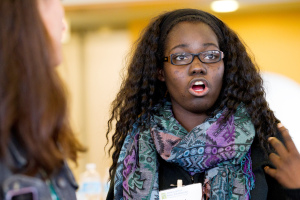
Exponent Philanthropy member Alexis Marion
What are you working on right now?
Currently, I’m serving a dual role as program assistant and junior board advisor. Participation in the junior board starts at age eight. Since its inception, junior board members have received $2,000 per year to make individual grants. In addition, our board approved a special Collaborative Grant of $50,000 for 2014 just for the junior board. I assist them in conducting a regular grant cycle, including due diligence, planning around grant application and review, coordinating meetings, reaching out to potential grantees, and attending site visits. Ultimately, the group reaches an agreement on the grants it would like to award and presents its recommendations to the foundation board.
Our foundation is at an interesting turning point. We recently added new board members and have experienced success with the Youth Philanthropy Connect program since its creation in 2010. As we become introspective and think strategically about the best path forward, I’ve also gotten involved in our strategic planning process.
What are you interested in, both in and beyond philanthropy?
Within philanthropy, I really love our youth philanthropy program. Philosophically, I love it; I love that we engage youth early on.
More generally, impact has been on my mind for a while now. When I attend conferences, I usually gravitate toward sessions on impact. I’ve noticed plenty of conversation about numbers—number of grant dollars, people served, and various achievements. I think the human aspect is missing. Why do we actually do this work? I don’t know how you measure that; is there even a way to think about it that makes sense to foundations?
Diversity is one of my other main interests. The word “diversity” tends puts people off from the get-go. One thing I think about is, “How do we include as many different perspectives as possible?” I know it’s possible and I believe it’s valuable. Perhaps this has something to do with being young and idealistic, but that’s also why I believe it’s so important to get young people involved and engaged.
At my foundation, when we want to include different perspectives, and by that I mean youth perspectives, we have to be flexible and intentional to make it work. For example, our junior board includes several elementary school students. For them to participate fully I put in more work: I drive to their school, pick them up, drive them home, and then spend a few hours with them while they review grant applications.
If your goal is to be more inclusive, then you need to go out of your way to make it happen. Help overcome barriers: transportation, childcare, training, education.
I get so much out of my work with the junior board, as do others at the foundation. It adds so much to the grantmaking experience and it sparks conversations you’d never expect to have. It’s well worth the effort.
What barriers are preventing us from increasing diversity in philanthropy?
One barrier is close-mindedness. Those of us that represent different perspectives don’t necessarily feel comfortable asking for the type of action that is really necessary because it can be received as too radical…too far outside of the norm. People ask me, “How do I get people with different perspectives involved?” My answer is that you have to be willing to do whatever it takes. And if you’re not willing to do that, it won’t happen. It can be difficult for some people to say that in a boardroom, in front of a larger audience, or even in one-on-one conversations.
Another barrier is generational. Gen Y and Gen Z see everything through the lens of diversity. Conversations about diversity are something we’ve always been part of—it’s a fabric of our being. Our perspective can be a little jarring for our older counterparts.
So how might we push past that barrier?
If we start by acknowledging that diversity is valuable and that we want a more diverse philanthropic community, more diverse foundation boards, and so on, it would help us push through to the next level. What actions are we willing to take to support others in becoming an effective part of our work, our board, our foundation?
At my foundation, we ask ourselves questions like these: How can we enhance our relationships with grantees by including their ideas, experiences, and knowledge of the field in our decision making and practices? Are there people in our community—either grantees, program participants, or other leaders—whom we can learn from? How do we ensure that our junior board members are active participants?
Intention is important but actions have even greater impact.
Related resources
Millennial Voices in Philanthropy: Jessica Gonzalez
Millennial Voices in Philanthropy: Caroline Mullis
Empower Millennials to Become Effective Philanthropic Leaders, Arabella Advisors
 Program Manager Stephen Alexander designs sessions for our educational programs and coordinates content production with the goal of delivering the best service possible to the Exponent Philanthropy community. Before coming to Exponent Philanthropy, Stephen worked with Thomson Reuters, Jones Lang LaSalle, and two small nonprofits in Washington, DC. Stephen currently serves on the board of the Young Nonprofit Professionals Network’s DC chapter. Follow Stephen on Twitter @salxndr and Exponent Philanthropy @exponentphil.

Pingback: Voices of Emerging Leaders in Philanthropy | PhilanthroFiles
Pingback: Eyeing Trends in Grantmaking: Youth Engagement | PhilanthroFiles