Put Your Point of View Into Play: 2014 National Conference Panelists Discuss Trends, Path to Solutions

By Courtney M. McSwain on behalf of Exponent Philanthropy

Changing U.S. demographic trends, advances in technology, political polarization, and geographic mobility all impact the way communities are addressing social problems today. This was the underlying message conveyed at Friday’s spotlight panel, on the second full day of Exponent Philanthropy’s 2014 National Conference.
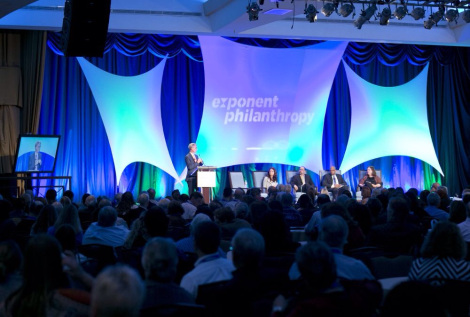
2014 National Conference spotlight panelPanel moderator Michael Dimock, president of the Washington, D.C.-based Pew Research Center, set the framework for the morning’s discussion by outlining social trends affecting philanthropy. The influence of Millennials was among the biggest trends discussed, especially the way younger citizens leverage technology to work outside of the walls of traditional institutions.

“Millennials want to see change, and they don’t care where the change is coming from,” said Gabriel Kasper, senior manager at the Monitor Institute.

The expert panel agreed that technology shifts, in many ways, facilitate Millennials’ ability to form nontraditional communities of change as well as create entrepreneurial approaches. “Millennials are bringing an entrepreneurial sprit to problem solving,” said Kim Jordan, co-founder and CEO of New Belgium Brewing and founder of the New Belgium Family Foundation.

Moreover, technology broadens access so that marginalized segments of society can circumvent institutions that shut them out. James Shelton, deputy secretary at the U.S. Department of Education, offered the ridesharing program Uber as an illustration of this point. “People think of it as a very convenient ride, [but] for thousands and thousands of people, it is a new small business,” Shelton said.

Patty Stonesifer, president and CEO of Martha’s Table, furthered this point by noting that the spirit of Uber will ultimately deliver disruptive innovations in philanthropic service delivery. “What’s the Uber of matching our excess food with families in need?” Stonesifer asked. “Technology can change the whole system…we’ve only scratched the surface of this.”

Continue reading →

The Pulse: Economic Hardship, Courage to Adjust Course

By Andy Carroll, Exponent Philanthropy

I regularly explore trends influencing philanthropy by spotlighting articles, reports, and essays in the media. I cast a wide net, venturing beyond philanthropy and traditional topics to consider a variety of ideas, innovations, debates, and critiques. Read previous posts in the series   

Working Americans Struggle to Earn a Living

Recent articles spotlight continuing economic hardship faced by millions of working Americans, including nonprofit employees, and the forces responsible. Key trends include the high cost of housing and health care, low wages, and lack of income growth in recent decades. According to the Center for Budget and Policy Priorities, median income for working-age households (headed by someone under age 65) slid 12.4% from 2000 to 2011, to $55,640.

I highlight two articles:

  • The San Francisco Chronicle profiles the impact on nonprofits of steep increases in the city’s real estate costs, which makes rents difficult to afford for employees and their organizations. The squeeze has fueled demonstrations by nonprofits and their supporters at City Hall and City Council meetings. Protesters point out that the mayor’s proposed increase in allocations for nonprofits is less than the increase for city workers, and call upon the city, which relies on nonprofits to deliver crucial human services, to increase its allocations. Journalist Marisa Lagos writes, “…nonprofits and their workers have seen little increase in the amount of money they get from the city—just 5% since 2007. From 2007 to 2012, there were no increases, and many have had to cut staff or services to stay solvent.” One nonprofit that offers housing, counseling, and other services to people with chronic mental health problems has seen rent hikes as high as 135% at some of its buildings.
  • The New York Times highlights a newer challenge for American workers–businesses’ use of computer scheduling models to increase staffing efficiency and reduce labor costs. The computer models disrupt regular work schedules, making it more difficult for parents to align work with their children’s daycare and school schedules. Journalist Jodi Kantor follows Jannette Navarro, a single mother in San Diego who struggles to support herself and her 4-year son on a $9-an-hour job. Ms. Navarro’s work schedule is cut into continually changing, irregular slices, forcing her to improvise her son’s daily care, and preventing her progress toward an associate degree in business. Writes Kantor, “Like increasing numbers of low-income mothers and fathers, Ms. Navarro is at the center of a new collision that pits sophisticated workplace technology against some fundamental requirements of parenting, with particularly harsh consequences for poor single mothers.”

A Nonprofit Shares Its Data and Improves Its Field

Continual innovation in technology offers new opportunities for funders and nonprofits to use data to make smart decisions. As thought leaders like Lucy Bernholz have pointed out, one promising use of data is for nonprofits and foundations to share their evaluation and research data publicly to increase effectiveness for all.

Continue reading →

8 Sources of Data to Inform Your Giving

By Akilah Massey, Exponent Philanthropy

Data has found its place in philanthropy as two important trends converge: a movement toward impact, and a surge of digital information from government, regulatory, and nonprofit organizations.

Exponent Philanthropy member Fran Sykes and fellow trustees of The Pascale Sykes Foundation use a mix of state data on school achievement and information from other government agencies to set the foundation’s funding priorities. She notes, “Every state has KIDS COUNT®. Every state has stats from its departments of labor, employment, corrections. Every state has stats on public school academic achievement. All are matters of public record and can be used to determine needs.”

And she is right: Public data is available from a variety of sources. And many more organizations are compiling, analyzing, and making data useful for donors and others.

Where can you find data to inform your giving? Here are 8 places to turn:

Continue reading →

Is Philanthropy Behind the Tech Curve?

By Akilah Massey, ASF

We all hear stories of groups less likely to be engaged with today’s technology. Often referred to as the “digital divide,” the focus tends to be on those who lack access to reliable Internet: seniors, people living in or close to poverty, and those in extremely rural areas. But when looking at the philanthropic sector, it’s easy to see another gap.

A few years ago, the Foundation Center found that less than less than one-third of U.S. foundations had even simple websites. In early 2013, the Foundation Center again found that just 34% of the country’s largest foundations had a social media presence. As technology continues to expand and change the ways we connect, are donors keeping up?

Continue reading →

3 Ways Any Foundation Can Use Twitter

By Christa Carignan, ASF

I was pondering over data from The Foundation Center’s recent study of foundations using social media.

  • 45% of foundations use social media, but just 34% of family and independent foundations do.
  • 74% of foundations on social media say it is useful in furthering philanthropy.
  • 41% of foundations manage their social media with communications staff.

For those who manage philanthropy from a small shop with few or no communications staff, adding social media to your to-do list can elicit utterances of, “Who has time for that?”

But consider how social media could support your philanthropy. Take Twitter, for example. It’s a great place to start. Sign up for a free account, “follow” several people or organizations of interest to you, and then simply listen. Get a feel for the medium (short messages with 140-character limits) and the lingo. See if you find valuable information—even inspiration!

You can use Twitter to:

Scan news related to the issues you’re passionate about.

Continue reading →

Our Foundation Needs a Technology Plan Too?

By Akilah Massey, ASF

Some people are natural planners. They’re the ones that never have to search for flashlight batteries when a big storm hits. They have well-stocked emergency kits and well-rehearsed household disaster plans.

On the other end of the spectrum are those that always end up searching for a candle or the extra batteries (in the dark) because they haven’t tested the emergency flashlight in years.

Unlike individuals, all healthy organizations should fall on the planner-heavy side of the spectrum. Planning for the future can help your operations run smoothly and make sure that everyone is on the same page. It almost always saves time and money.

While at the Nonprofit Technology Conference in San Francisco last month, I had a chance to think about how and why ASF members might plan for their technology needs. Depending on your foundation, this might mean deciding when to upgrade your computers, creating a website or blog, or making sure that staff and trustees are appropriately trained on the technology tools that your foundation uses.

Continue reading →