By Courtney M. McSwain on behalf of Exponent Philanthropy
Changing U.S. demographic trends, advances in technology, political polarization, and geographic mobility all impact the way communities are addressing social problems today. This was the underlying message conveyed at Friday’s spotlight panel, on the second full day of Exponent Philanthropy’s 2014 National Conference.
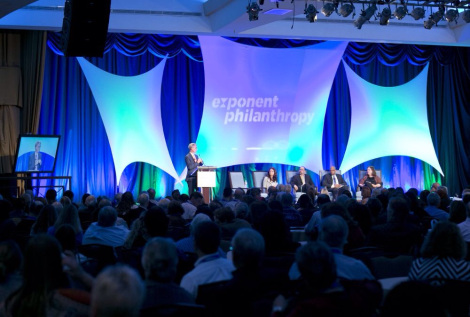 Panel moderator Michael Dimock, president of the Washington, D.C.-based Pew Research Center, set the framework for the morning’s discussion by outlining social trends affecting philanthropy. The influence of Millennials was among the biggest trends discussed, especially the way younger citizens leverage technology to work outside of the walls of traditional institutions.
“Millennials want to see change, and they don’t care where the change is coming from,” said Gabriel Kasper, senior manager at the Monitor Institute.
The expert panel agreed that technology shifts, in many ways, facilitate Millennials’ ability to form nontraditional communities of change as well as create entrepreneurial approaches. “Millennials are bringing an entrepreneurial sprit to problem solving,” said Kim Jordan, co-founder and CEO of New Belgium Brewing and founder of the New Belgium Family Foundation.
Moreover, technology broadens access so that marginalized segments of society can circumvent institutions that shut them out. James Shelton, deputy secretary at the U.S. Department of Education, offered the ridesharing program Uber as an illustration of this point. “People think of it as a very convenient ride, [but] for thousands and thousands of people, it is a new small business,” Shelton said.
Patty Stonesifer, president and CEO of Martha’s Table, furthered this point by noting that the spirit of Uber will ultimately deliver disruptive innovations in philanthropic service delivery. “What’s the Uber of matching our excess food with families in need?” Stonesifer asked. “Technology can change the whole system…we’ve only scratched the surface of this.”
Panelists agreed that important shifts are challenging long-held assumptions in the social-impact sector. It was on this topic that attendees were able to delve deep during breakout discussions. Each panelist moderated a different breakout, including Kasper, who led conference goers in an interactive exercise designed to turn “philanthropy orthodoxies,” or assumed ways of doing things, on their head. Attendees of Kasper’s session found themselves debating topics ranging from the role of foundations in public policy, to evaluation and moving outside of the nonprofit grant delivery model. Although opinions varied on such issues, participants generally saw the value in occasionally reflecting on these bigger questions.
If nothing else, Friday’s spotlight panel and breakout sessions affirmed the need for the philanthropic community to embrace having a point of view—whatever it might be.
“Every philanthropist I’ve ever met comes at things with a point of view,” said Shelton. “It takes a point of view to get things going.”
Related post: 2014 National Conference Opens to Themes of Urgency, Impact
Courtney McSwain is a Washington, DC-based freelance writer consulting with nonprofits and mission-based organizations to tell the stories of their work.

Pingback: 2014 National Conference Panelists Discuss Trends, Path to Solutions | Charity Spring
Pingback: Inspiration, Outsized Impact at Close of 2014 National Conference | PhilanthroFiles
Pingback: Philanthropy Debates Its Role | PhilanthroFiles
Pingback: Philanthropy Debates Its Role | IHRFG