By Jill Blair, Jill Blair Consulting
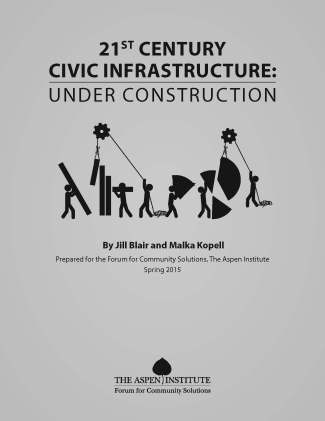 Like bridges, tunnels, and roads that compose our physical infrastructure and enable us to live more relational and economically vibrant lives, Malka Kopell and I argue in the recently released monograph 21st Century Civic Infrastructure: Under Construction that a well-designed civic infrastructure can be facilitative as well.
What is civic infrastructure?
It is the basis upon which ordinary people are able to participate in ordinary civic life, from joining neighborhood watch groups to entering the voting booth. Civic infrastructure comprises venues, policies, programs, and practices that enable us to connect with one another, address our shared concerns, build community, and solve problems.
Much of our 20th century civic infrastructure emerged as a product of philanthropic investment—organizations and programs intended to advance equity, education, and economic opportunity. And so we call upon philanthropy, large and small, to help lead the construction of a 21st century civic infrastructure that leverages the resources we now have to solve the problems we still face.
To identify the fundamental basis for a 21st century civic infrastructure, we reviewed literature and engaged in conversations with people committed to public problem-solving—leaders across business, philanthropy, nonprofits, and government. We landed on what we call keystones of 21st century civic infrastructure, the qualities that should be present in the programs and organizations we support:
- Engaging all sectors. The boundaries between sectors are dissolving as we understand that the problems that plague our society—from income inequality to the achievement gap—affect us all. To that end, we should mindfully support and encourage those who seek to engage all sectors in the problem-solving enterprise. When and why do we resist setting more places at the table for cross-sector participation? When and why do those in whom we invest welcome public and private sector participation in their work? What more do we need to learn and share to be better partners with others?
- Enlisting all voices. The 21st century has brought us tools and technologies for real-time feedback from consumers of services. It is time to employ those tools to hear the voices of those whose lives we seek to improve—those on the margins who must be brought to the center. Who qualifies as on the margins in the work we support, and how are we hearing their voices? When are the voices of ordinary people incorporated into the strategies we support and how? Who are our constituents, and how do we engage with and listen to them?
- Building vertical and horizontal thoroughfares. The 21st century is the century of information exchange. Our 21st century civic infrastructure must include capacity to move information, knowledge, policy, and practice from local to national and down again, as well as between and among like-minded efforts. To what extent are we communicating with others in our fields of practice/interest, and to what end? To what extent should and do those in whom we invest seek to contribute and influence public policy to scale their success by sharing it? Where are we sharing with and learning from others, and how are we putting that learning into practice?
This monograph is a work in progress, meant to stimulate community conversations that consider how to strengthen, supplement, or reinvent local civic infrastructure. Philanthropy has an important role to play, not only in hoisting these conversations in local communities but in examining its own behaviors and investments and in identifying ways to encourage the conscious construction of a 21st century civic infrastructure that offers the strongest possible foundation for the greatest possible participation of ordinary people in ordinary life.
Jill Blair is a firm believer in the power of people to effect positive change. Her day job is to consult with nonprofits and philanthropy on issues of strategy, leadership, and organizational development. Her passion is democratic practice. She is founder of PACE (Philanthropy for Active Civic Engagement).
Malka Kopell has spent much of her life trying to get people to work together better in the civic context. She has done that in a variety of roles, as nonprofit leader, philanthropy program officer, director of an academic research institution, and as a consultant to nonprofits and government. She recently co-founded The Civity Initiative, which helps strengthen civic networks, particularly across divides, to support community problem-solving and resilience.
