Why It’s Important to Start Planning for Leadership Succession Now

By Jill Blair, strategy and organizational consultant, and Jeffrey M. Glebocki, CEO, Strategy + Action/Philanthropy

Passing the batonThis post is the first in a 2-part series on leadership succession planning. Exponent Philanthropy members can explore these themes further in an article by the same authors in our forthcoming Fall 2015 issue of Essentials.

“Our foundation had succession planning thrust upon us,” shares John Valliant, president of the Grayce B. Kerr Fund. “We had been talking about succession for some time, and then we were blindsided by illness and death.”

Fortunately, not every foundation faces such sudden and tragic events. But experiences of this nature are profound reminders of the importance of intentionally preparing for the future.

We know that leadership transitions are inevitable, and that they are moments of evolution and change that affect people and organizations. Leadership transitions can also be disruptive and create a sense of loss—so much so that we often choose to avoid thinking ahead and acting on that inevitability.

The good news is that we can manage transition by being prepared in the form of succession planning. There are many dimensions of succession, from changes in board members or board and staff leadership to engagement of next generations. In every case, leadership succession is fundamentally about the orderly transfer, or sharing, of power.
Continue reading →

Philanthropy’s Role in Constructing a 21st Century Civic Infrastructure

By Jill Blair, Jill Blair Consulting

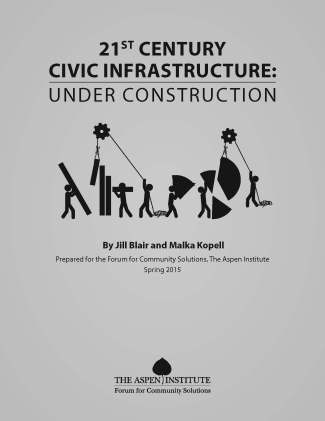
21st-Century-Civic-InfrastructureLike bridges, tunnels, and roads that compose our physical infrastructure and enable us to live more relational and economically vibrant lives, Malka Kopell and I argue in the recently released monograph 21st Century Civic Infrastructure: Under Construction that a well-designed civic infrastructure can be facilitative as well.

What is civic infrastructure?

It is the basis upon which ordinary people are able to participate in ordinary civic life, from joining neighborhood watch groups to entering the voting booth. Civic infrastructure comprises venues, policies, programs, and practices that enable us to connect with one another, address our shared concerns, build community, and solve problems.

Much of our 20th century civic infrastructure emerged as a product of philanthropic investment—organizations and programs intended to advance equity, education, and economic opportunity. And so we call upon philanthropy, large and small, to help lead the construction of a 21st century civic infrastructure that leverages the resources we now have to solve the problems we still face.

To identify the fundamental basis for a 21st century civic infrastructure, we reviewed literature and engaged in conversations with people committed to public problem-solving—leaders across business, philanthropy, nonprofits, and government. We landed on what we call keystones of 21st century civic infrastructure, the qualities that should be present in the programs and organizations we support:

Continue reading →